

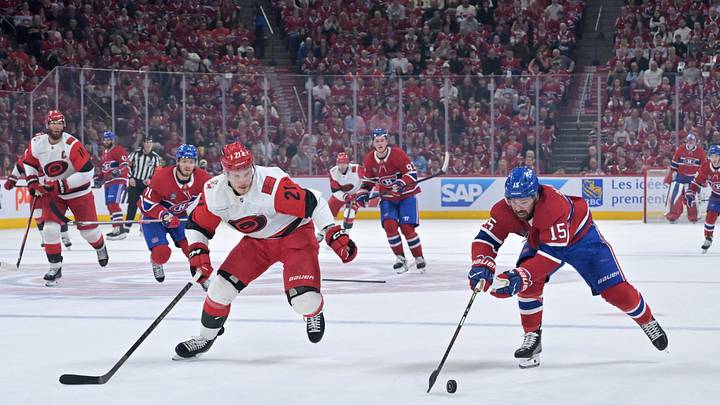
Throughout the playoffs, the Montreal Canadiens have adjusted their style of play depending on the opponent. To this point, their strategy has been effective, taking down the Tampa Bay Lightning and Buffalo Sabres in two tightly contested series. The game plan looked to be working in Game 1 of the Eastern Conference Final against the Carolina Hurricanes.
The Canadiens managed to win the majority of the puck battles along the boards, which worked perfectly with their quick transition game, and they capitalized on their chances. Since then, the Hurricanes have found their stride and have put the Canadiens under intense pressure throughout the games. While Montreal lost both Game 2 and Game 3 in overtime, they were completely outshot. The Hurricanes had 65 shots to the Canadiens 25 in those two games, and if Montreal does not want to risk going down 3-1 in the series, they need to change their approach.
Canadiens need to find a way to take more shots
It is clear from the shot totals that the Canadiens are not getting enough shots on Fedrik Anderson. The Canadiens' game plan is to prioritize high-quality chances over quantity of shots, but at the same time, you will not win many playoff games if you only get 12 and 13 attempts on net. The Hurricanes, on the other hand, have the complete opposite approach. They try to suffocate you in your own zone, while taking shots from absolutely anywhere, trying to deflect pucks or pick up a loose rebound. That is not to say the Canadiens need to go to the same extremes as the Hurricanes, but if they do get some open space or a free lane to shoot, take advantage because you never know what type of bounce the puck can take on its way to the net.
The Hurricanes lead the entire NHL playoffs in Corsi %, which takes into account the percentage of total shot attempts your team creates compared to the opponent while at even strength. Carolina has a Corsi % of 60.42%, which is extraordinary considering anything above 55% is considered elite. The Canadiens have a Corsi % of 44.18%, the second-worst mark of all the teams that made the playoffs. However, when Montreal do take shots on net, there is a high chance they result in a goal. The Canadiens are second in the playoffs in shooting percentage on shots on goal with 13.25%, sitting behind the Vegas Golden Knights. Montreal does not need to match Carolina’s shot quantity, but they do need to find a way to create more quality chances.
Montreal needs to clean up the defensive turnovers
A byproduct of the Hurricanes' high-pressure game plan is that they force the Canadiens to try to make plays before they are fully ready, leading to turnovers. The Canadiens gave the puck away 21 times in Game 3, and while some were unforced, the Hurricanes created 13 turnovers compared to Montreal’s 3. The clear and obvious one from Game 3 was the overtime winner. Lane Hutson had an uncharacteristic turnover on the Canadiens blueline that led to Andrei Svechnikov's game-winner. The blame cannot be placed solely on Hutson, as the Canadiens did a terrible job retrieving the puck along the boards or clearing bodies away from the net, but the sequence began with a turnover.
It is not just intercepted passes that have been causing the Canadiens problems. There have been multiple instances where the team struggles to dump the puck out of their zone, which would help relieve the Canadiens from all the pressure the Hurricanes are creating. Failing to dump the puck into the opposing zone has also become a problem, directly causing the Hurricanes' winning goal in Game 2. After a failed dump-in attempt by Oliver Kapanen, Hurricanes’ defenceman Jalen Chatfield pushes the puck up the ice, finding its way to Nikolaj Ehlers, who ends the game in overtime. Both of Carolina’s overtime winners have come directly after turnovers, and if the Canadiens want to get back into the series, they need to do a better job of limiting their mistakes.
 Add us as a preferred source on Google