

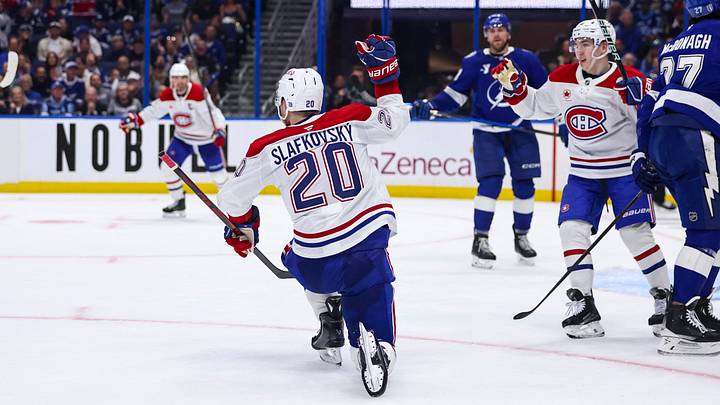
When the Montreal Canadiens took Juraj Slafkovsky with the first overall pick in the 2022 NHL Entry Draft, the team knew he would be a project. He had all the measurables. With his 6’3” frame, he has the rare combination of speed and stick-handling ability to be a dominating force in the NHL. He recorded 10 points in 39 games for TPS Turku in Finland in his draft year, and while those numbers are not exactly eye-popping, it was what he did on the international stage that caught everyone's attention. Slafkovsky struggled as a rookie to adjust to the NHL game, but now, following the most productive season of his career, is there still another level that he can reach?
Slafkovsky has everything it takes to be elite
If you watched Slafkovsky during the 2022 Olympics and the IIHF World Championship, you would have thought the Canadiens were getting a one-man wrecking crew. During the Olympics, he was a goal machine, scoring seven goals in seven games, helping Team Slovakia win Bronze, their first-ever medal in ice hockey. At the IIHF World Championship, Slafkovsky demonstrated his complete game, recording three goals and six assists in eight games, falling just short of the medal games. Given how well he was playing before the draft, the thought was that he could come to the NHL and be effective immediately, but that was not the case. For most players, there is an adjustment period as you try to get used to the speed and physicality of the NHL game. Slafkovsky was no different. He had just four goals and six assists in 39 games before a knee injury sidelined him for the rest of the season.
Over the next two seasons, Slafkovsky showed growth, but struggled with consistency. He recorded his first 20-goal, 50-point season in 2023-24, followed up with a 51-point campaign the next year despite the goal total dropping to 18. The potential was there, but too often Slafkovsky would disappear for long stretches of the season. Last season was when everything finally came together. Following a modest start to the season, Slafkovsky’s production exploded once he was paired with Oliver Kapanen and Ivan Demidov. Instead of being just another piece of the puzzle on the top line with Nick Suzuki and Cole Caufield, Slafkovsky was spearheading the offence on the second line. He later returned to the first line with Suzuki and Caufield, but brought the newfound confidence with him. He set new career highs in goals (30), assists (43), and points (73). At times last season, Slafkovsky looked dominant, and even with him setting new career bests, he likely still has another level to his game that he has not reached yet.
Canadiens are at their best with Slafkovsky driving a line
Slafkovsky proved last season that he can be a catalyst on a line, but it was nothing compared to what he did at the 2026 Olympics in Milano-Cortina. Some dismissed his performance at the Beijing Olympics because NHL players were not allowed to compete. He proved that when he puts on that Slovakia jersey, he is a completely different player. He opened the tournament with a three-point performance, upsetting Finland, who would go on to win the bronze medal. He finished the Olympics with four goals and four assists in six games, showcasing that in the big moments he can be someone you depend on. Even with his excellent season with the Canadiens, his performance at the Olympics proves we still have yet to see the best from Slafkovsky.
At Slafkovsky’s best, he uses his size and speed to effortlessly break through the neutral zone and create plays off the rush. We see it consistently when he plays with Slovakia. With the Canadiens, sometimes he gets lost. Suzuki and Caufield are clearly the team’s offensive focal points, and it looks like Slafkovsky is ok with deferring to them, while making sure to do all the little things to retrieve the puck. For the Canadiens to be true Stanley Cup contenders, they need Slafkovsky to be an offensive force. For that to be the case, he has to move away from Suzuki and Caufield. It would make the Canadiens harder to play against, giving them two lines to rely on for offence, while also unlocking Slafkovsky’s untapped potential, which we have only witnessed at international tournaments. Slafkovsky has all the tools to be a physical force. The Canadiens need to allow him to show it.
 Add us as a preferred source on Google