

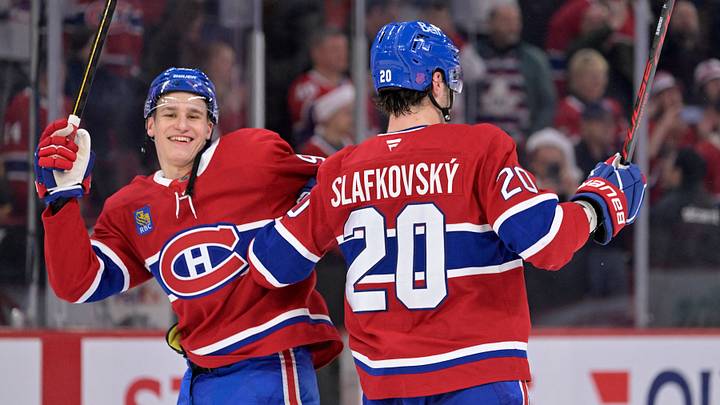
The Montreal Canadiens are off to a winning start. It is just the preseason, so do not overreact, but there were plenty of positives to take away from both games. While we saw the Canadiens' lines at practice during the week, the biggest takeaway from both games was the “Kid Line” reuniting. Two weeks ago, before adding Chris Kreider, the expectations were that the team would be led by the Juraj Slafkovsky, Nick Suzuki, and Cole Caufield trio. The Canadiens tried to move Slafkovsky off the first line last season, but the line struggled without him. The Kreider signing changed things. He gives the Canadiens another option on their top line, bringing physicality and a net-front presence they lacked when Slafkovsky was playing on the second line.
Slafkovsky and Demidov are the Canadiens' new dynamic duo
Since coming into the NHL, Suzuki and Caufield have been inseparable. The duo has played on the same line for pretty much the entire Martin St. Louis era. Slafkovsky joined that line a couple of years later, and together they formed one of the NHL’s best lines. Few lines in the league can boast a 50-goal scorer, a 30-goal scorer, and a 100-point player. The only problem is that having those three together makes the Canadiens one-dimensional. We saw in the playoffs that if the first line is not producing, Montreal struggles to score. Adding Kreider changes that. The Canadiens can balance their top two lines by moving Kreider to the first line and moving Slafkovsky to the second. Moving Slafkovsky to line two could give the Canadiens yet another dynamic duo.
As a rookie, Ivan Demidov displayed just how elite his playmaking and stick-handling abilities are. However, he was at his best when playing alongside Slafkovsky. Together, with Oliver Kapanen, they formed the team’s most dependable offensive line, especially while the team battled through injuries to key players. The move to the second line did wonders for Slafkovsky’s game. On the first line, it felt like he was there to complement Suzuki and Caufield, but with Demidov and Kapanen, he was the engine that made that line tick. He looked more like the player we saw in the last two Olympics than he did in his first three seasons with the Canadiens. He brought that confidence boost with him when he moved back to the first line, but the move negatively affected Demidov’s play.
Demidov struggled near the end of the season. Some of those struggles could be because he had never played that many games in a season before, but who he played with may have also contributed. Once Slafkovsky moved back to the first line, it was a revolving door of who would play on the opposite side of Demidov. In the playoffs, it got more difficult for Demidov, as Kapanen was taken out of the lineup. Jake Evans, a defence-first centre, was the Canadiens' second-line centre, putting more pressure on Demidov to produce on offence. Moving him back with Slafkovsky would give him an elite-level player to play alongside, which, in turn, would make Kapanen’s job a lot easier.
Canadiens do not need to rush for a second-line centre
As we get closer and closer to the start of the regular season, the question remains: are the Canadiens good enough at second-line centre? The Canadiens' biggest need is a second-line centre, but the team is going into this season with nearly the same centre core. Either other teams' asking prices were too high, or the Canadiens felt the players available were not a good fit for their squad. Montreal will likely be going into this season with Kapanen as their second-line centre. While he might be below the mean for that position across the NHL, the Canadiens do not need him to be an offensive force if he plays with Slafkovsky and Demidov. Kapanen has his positives. He is good in the defensive zone and possesses a high hockey IQ, which helps him find loose pucks around the net. What he does not excel at is driving the offence forward, but he would not have to with Slafkovsky and Demidov.
Reuniting the “Kid Line” allows Kapanen to focus on what he does best: playing responsibly defensively and getting to the net for loose pucks and rebounds. Slafkovsky and Demidov excel at generating offensive chances, taking away that pressure from Kapanen. In an ideal world, Kapanen would be a very good third-line centre, but the Canadiens do not have that luxury right now. If a player becomes available and the trade package makes sense, the Canadiens should absolutely consider it, but they should not be in a rush to make a deal happen.
 Add us as a preferred source on Google